Biological Virus Simulation
Tools
Electron, HTML, CSS, Node.js
Timeline
1 Month

What factors drive viral mutation and survival in a population? And how can we model the tradeoffs between spreadability, stability, and lethality in a controlled environment?
For my final science project, I built a custom biological virus simulation to explore how different viral characteristics affect population-scale outcomes. The goal wasn't to predict real-world pandemics, it was to demonstrate systems design thinking and turn epidemiological concepts into working algorithms.
How It Works
The simulation models virus behavior through a mathematical framework I designed around protein counts, mutation rates, and environmental factors. Each virus has a genetic type (RNA or DNA), protein count, and stability rating that directly affects how it spreads and mutates over time.
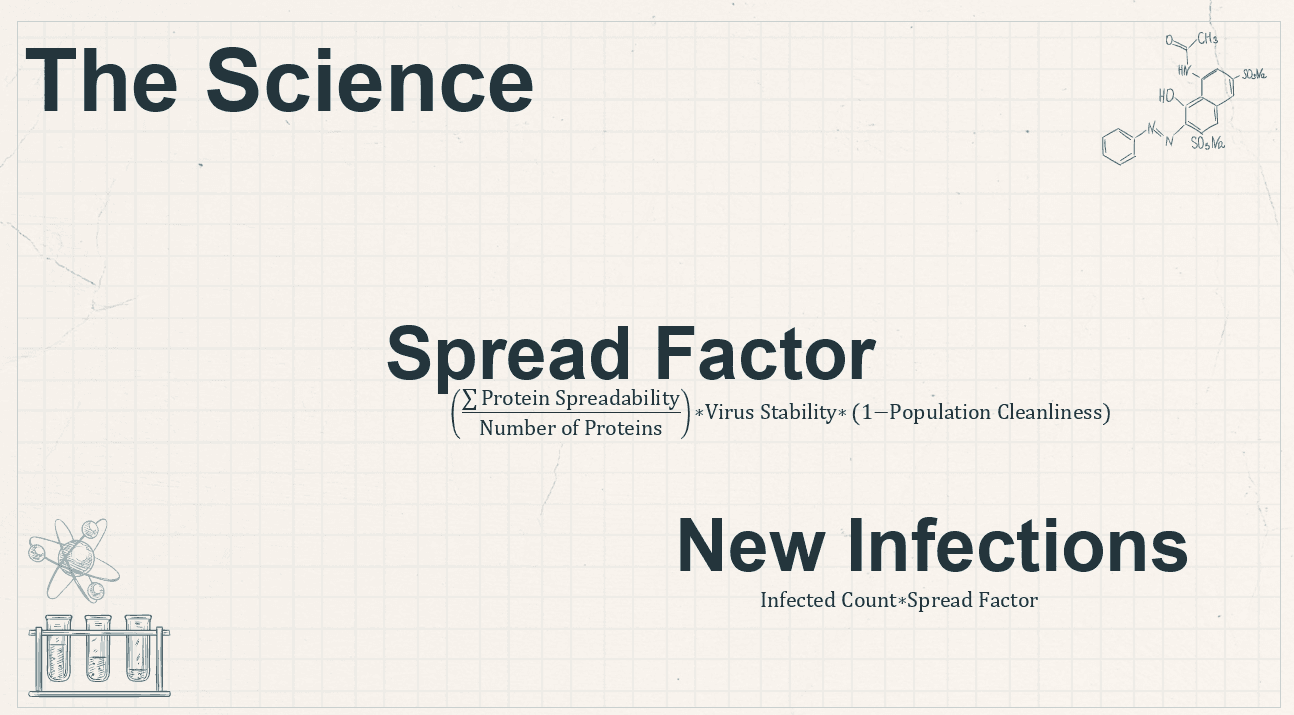
The core equation calculates spread factor as: (Protein Spreadability / Protein Count) × Virus Stability × (1 - Population Cleanliness)
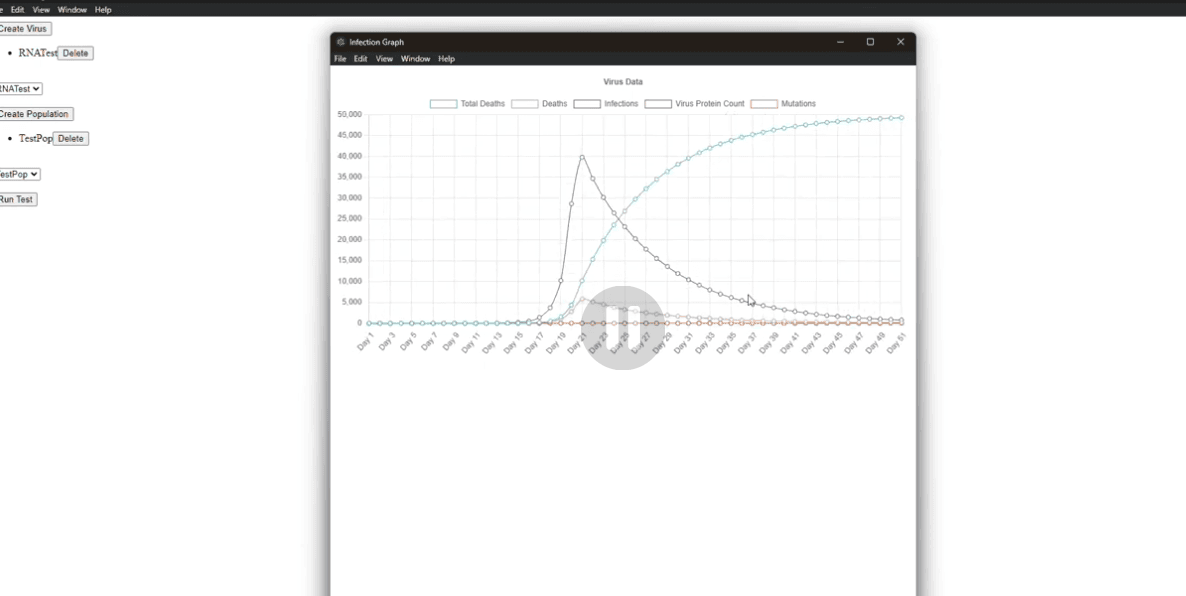
From there, new infections are determined by multiplying the current infected count by the spread factor. RNA viruses mutate more frequently but spread faster. DNA viruses are more stable but slower to adapt. The simulation tracks mutations, deaths, infections, and total population over time, outputting comprehensive data charts and graphs.

Key Findings
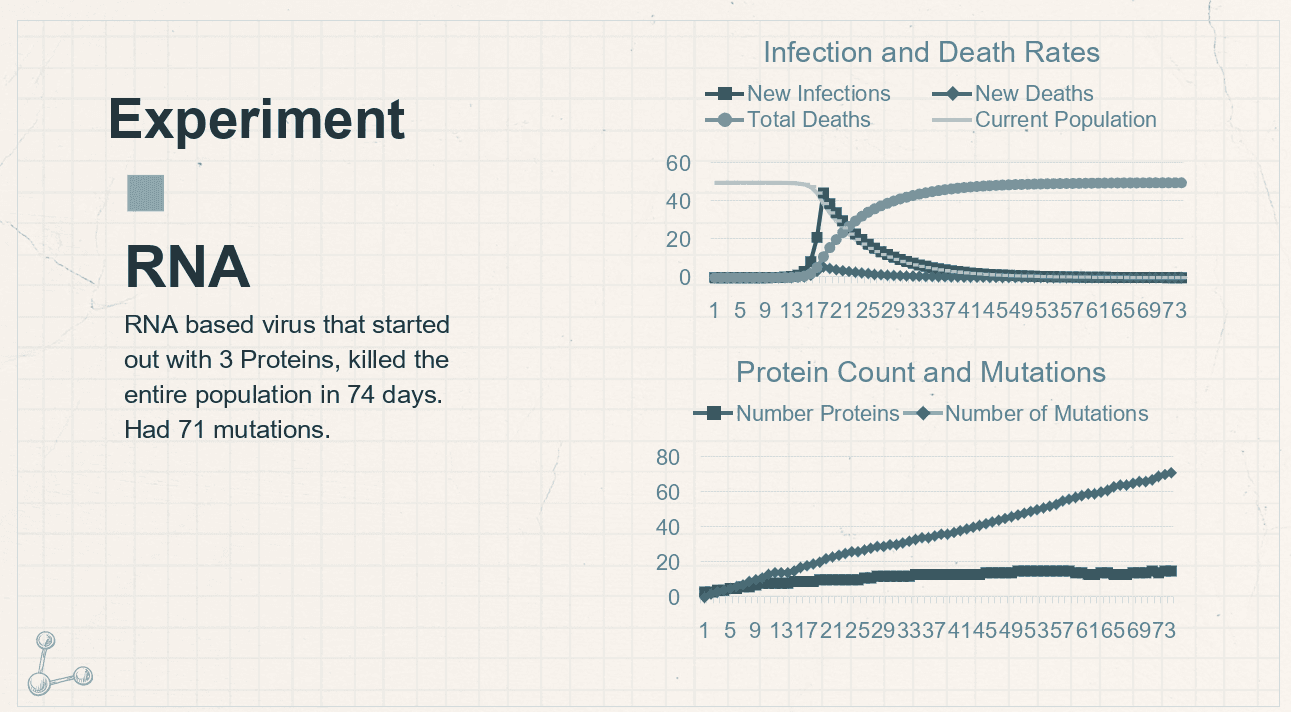
The simulation revealed some interesting patterns. RNA-based viruses in the test scenario killed the entire population in 74 days with 71 mutations, while DNA-based viruses took 120 days but only had 3 mutations. The data showed that high mutation rates create faster spread but also faster burnout, while stable viruses last longer but may struggle to establish initial footholds.
The tradeoff between spreadability and stability turned out to be the critical factor, viruses need enough adaptability to spread efficiently, but too much mutation can destabilize their core infection mechanisms.
The Technical Side
Built as an Electron desktop application, the simulation handles real-time data visualization, configurable parameters, and exportable results. The algorithm engine runs custom mathematical models I developed based on epidemiological research, with a clean UI for adjusting population size, cleanliness factors, viral starting conditions, and mutation rates.
The system was designed to be modular and extensible. Future improvements could include machine learning algorithms for smarter virus and population behavior, more detailed protein types with granular characteristics, and better data collection and storage systems.
Why This Matters
This project demonstrates my ability to translate complex theoretical concepts into functional software systems. It's algorithm design, systems architecture, mathematical modeling, and UI development all rolled into a single working application. The research was purely academic, but the technical skills behind it, translating real-world phenomena into code, building simulation engines, handling real-time data visualization, are directly applicable to game development, backend systems, and any project that requires turning abstract logic into something that actually runs.
Academic Context
Research Purpose Only: This simulation was built purely for academic research and demonstration of software design capabilities. All modeling was theoretical and designed to showcase algorithm implementation and systems thinking rather than any real-world application.